Article · SAP
From SAP Business ByDesign to SAP S/4HANA Cloud: What Executives Need to Decide in 2026
The Migration Playbook for a New Generation of SAP ERP
· 6 min read
For years, SAP Business ByDesign customers could treat the “ERP future” question as a someday problem. That window is closing, but not in the way the headlines suggest. SAP continues to support and release new versions of ByDesign, the 26.05 release shipped in May 2026 so no customer is being forced off the platform overnight. What has changed is direction, not deadline: SAP has built a formal, tooled transition path from Business ByDesign to SAP S/4HANA Cloud, and its 2026 investment, AI embedded in core processes, continuous releases, a redesigned midmarket strategy, is now visibly concentrated on the Cloud ERP platform, not on ByDesign.
For a CFO or COO, that reframes the question. It is no longer “when will SAP make us move,” but “what should our ERP foundation look like for the next five to ten years, and is the platform we outgrew years ago still the right one to build on.”
Why this is a business decision, not an IT refresh
Business ByDesign was built for fast-growing, midsize organizations that needed a scalable and integrated but simple cloud ERP. Many of today’s ByDesign customers are no longer that company. Additional entities, countries, products, approval chains, and integrations have been layered on year after year and the original question, “can ByDesign run this,” has quietly become “what should we run instead.”
SAP S/4HANA Cloud Public Edition is a different kind of platform: standardized processes, continuous innovation cycles, embedded analytics, and a fast-expanding set of AI capabilities across finance, procurement, manufacturing and service. The gap between the two isn’t a feature list, it’s an operating model. That is precisely why this decision belongs with the executive team and not solely with IT: it determines how the company will run, not just what system it will run on.
Five transformations, not one data migration
The most expensive mistake in this kind of project is defining success as “getting the old data into the new system.” A ByDesign-to-S/4HANA program is really five coordinated transformations happening at once:
- Business process: what the organization will actually do inside S/4HANA
- Organizational structure: company codes, plants, sales orgs, purchasing and reporting lines
- Data: converting ByDesign records into target-compatible structures
- Integration: redesigning every external connection the ERP touches
- People: preparing employees for new roles, applications and ways of working
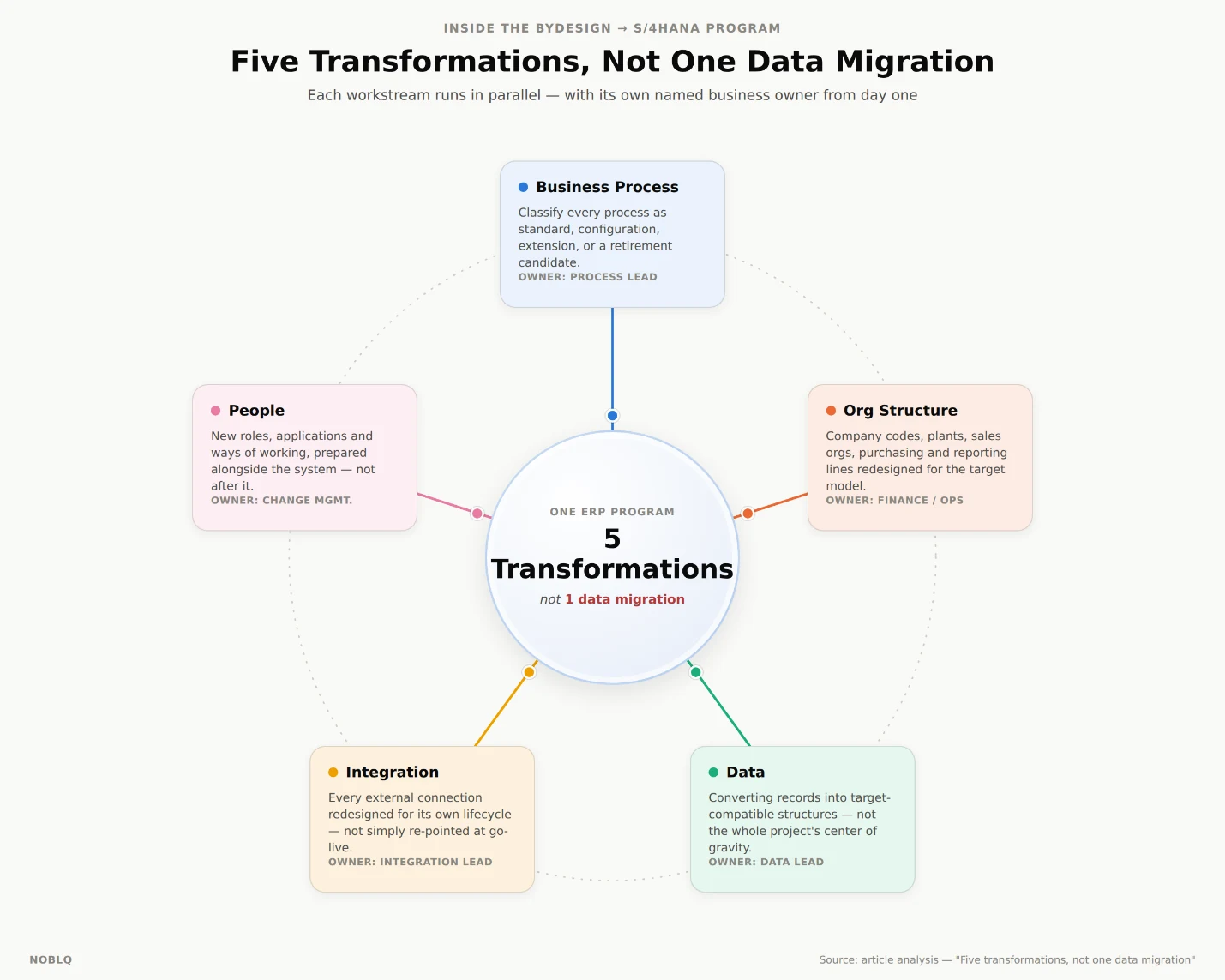
Treating “data migration” as the center of the project and asking everything else to adapt around it is the single most common cause of cost overruns and delayed go-lives. Executives should insist on all five workstreams being planned and owned from day one, with a named business owner for each.
Fit-to-standard: the discipline that determines your ROI
Every long-lived ERP accumulates local workarounds that users have come to treat as mandatory. Very few actually are. SAP’s own transition guidance is explicit on this point: the objective is not to reproduce ByDesign inside S/4HANA, but to preserve genuine business and regulatory outcomes while retiring the process variations, manual approvals and spreadsheet dependencies that no longer create measurable value.
This is where the business case is actually won or lost. A migration that quietly rebuilds every historical customization inherits the old cost structure in a new system. A migration governed by fit-to-standard discipline, asking, process by process, “is this a real requirement or an old habit”, is what converts a technical project into a genuine modernization.
The practical starting point: a full inventory of every active ByDesign process, each one classified as standard target capability, configuration, extension, integration requirement, or retirement candidate, with a named business owner.
SAP’s Digital Discovery Assessment can accelerate this by using an exported Business Adaptation Catalog from ByDesign as a starting input, but the classification decisions still belong to the business, not the tool.
Integrations turn an ERP project into an enterprise project
A ByDesign footprint that looks simple from inside the ERP is rarely simple from the outside. Banks, payroll, CRM, EDI, logistics, e-commerce and reporting tools all typically connect into it. Each of these interfaces needs an explicit decision: retain, redesign, replace, consolidate or retire, because migration interfaces and production interfaces have entirely different lifecycles.
The temporary pipe that moves ByDesign data into S/4HANA during cutover is not the same thing as the bank statement feed that has to survive every future release. Conflating the two is a frequent and avoidable source of post-go-live incidents.
Extensibility: the clean-core question
For every custom field, workflow or bolt-on solution accumulated over the ByDesign years, the honest question is whether it reflects a genuine differentiator, a regulatory obligation, or simply an old workaround nobody has revisited. Standard S/4HANA Cloud functionality should win by default; extension should be reserved for where it genuinely matters. This isn’t a purity exercise, it directly determines how expensive and disruptive every future upgrade will be.
Public or Private Cloud Edition; decide this deliberately
SAP S/4HANA Cloud Public Edition is the natural landing zone for most ByDesign customers moving toward standardized, fast-innovating cloud operations. Organizations with heavier customization needs, more complex regulatory footprints, or acquisitive growth plans should weigh Private Cloud Edition and SAP’s two-tier ERP model on their merits, not by default to whatever the implementation partner already knows.
This decision belongs in the assessment phase, made against process complexity, geographic scope and growth strategy, not decided by momentum once a project is underway.
AI raises the stakes on getting the foundation right
SAP’s 2026 direction including its Business AI Platform and “Autonomous Enterprise” positioning makes one thing clear: AI is becoming part of the ERP platform itself, not a bolt-on project. But the case for migrating is not “to get AI.” It’s that standardized processes, governed master data and integrated transactions are the precondition for AI to operate reliably at all.
Data governance and process simplification undertaken during the transition become an AI-readiness investment as much as a migration one, a point SAP’s own leadership has made directly: durable AI value depends on business context and trusted data, not the model alone.
What the business case must actually contain
A credible board-level case goes well beyond subscription cost. It should quantify expected impact on financial close time, manual reconciliation effort, procurement compliance, order-to-cash speed, inventory visibility and reporting effort, each with a baseline, a target, an owner and a measurement date.
The cost side must include data cleansing, integration redesign, testing, training, temporary productivity loss and post-go-live stabilization, not just services and licensing. Reference projects can run from a few months to considerably longer; treat any timeline you’re shown as a data point, not a promise, until it’s tested against your own data quality, integration footprint and organizational readiness.
The assessment is the decision that matters right now
Companies do not need to sign an implementation contract this quarter. What they do need is a fact-based assessment: process fit, data complexity, integration exposure, target architecture and a quantified business case, before committing to timing, partner or scope.
If an organization cannot produce a target scope, a fit-to-standard matrix, a data-quality report and an integration inventory, it isn’t yet ready to migrate, regardless of how compelling the platform demo looks. If it can, the decision becomes a rational one made on the company’s own timeline, not a reaction to market pressure.
How Noblq approaches this
Noblq is an SAP Gold Partner with delivery experience spanning SAP S/4HANA, SAP Business ByDesign and SAP Business One, alongside ServiceNow implementations and cross-platform integration across Microsoft and Salesforce. Our approach to a ByDesign-to-S/4HANA transition starts where this article does: with a scoped, evidence-based assessment of process fit, data quality and integration exposure. Because the organizations that treat this as a business transformation, not a technical export-and-import exercise, are the ones that come out the other side with an ERP that’s actually ready for the next decade.
Related case studies

47 Gaps Found in Two Days, and One Costed Way Forward
A mid-market manufacturer let down by a previous SAP partner had no evidence-based view of what was broken. We ran a two-day, live-system proof of concept across procurement, sales and finance, surfacing 47 functional gaps in three modules and one clear, costed path forward.

Finance Effort Down 30%, With 84% User Adoption in Phase One
A century-old global automotive parts manufacturer had limited supply-chain visibility and largely manual finance processes. We implemented SAP Business ByDesign as one scalable cloud Enterprise Resource Planning (ERP) platform across core functions and standardized finance, logistics, project management and HR on it. Financial processing effort fell 30%, with 84% user adoption in phase one.

A New Legal Entity Live Fast, Cleanly Integrated Across 4 Countries
A global technology enterprise needed a dedicated Enterprise Resource Planning (ERP) system for a brand-new legal entity. We won the work against tier-one bidders, deployed SAP Business ByDesign for the entity, and integrated it cleanly with the group's ECC/S4 core across a four-country delivery footprint.